artist american
Ornette Coleman
1930–2015 · Fort Worth TX → Los Angeles CA → New York
The most controversial man in jazz: Ornette Coleman's free jazz removed harmony and the chord sequence from improvisation and replaced them with pure melodic intuition.
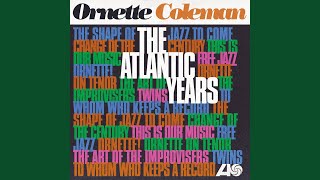
When Ornette Coleman arrived at the Five Spot Café in New York in November 1959 with his quartet — Don Cherry on pocket trumpet, Charlie Haden on bass, Billy Higgins on drums — the jazz world split in two. Some musicians (Miles Davis, Charles Mingus) thought he was playing out of tune and didn’t know what he was doing. Others (Leonard Bernstein, Gunther Schuller) thought he was a genius. Coleman’s debut album The Shape of Jazz to Come had just been released on Atlantic, and the debate about what he was doing — and whether it was jazz at all — filled every jazz publication and spilled into the mainstream press.
What Coleman was doing, he called harmolodics: a theory of improvisation based on the idea that melody, harmony and rhythm were equal and interchangeable, and that the chord sequence that had organized jazz improvisation since bebop was an artificial constraint. In his music, the musicians improvised melodically without reference to a pre-set harmonic structure, responding to each other’s lines in real time. The result sounded both completely free and (to sympathetic ears) deeply logical.
“Lonely Woman” — from The Shape of Jazz to Come (1959) — is the first great document of free jazz: a melody of such lyrical intensity that it made the absence of a chord structure feel not like a lack but like a different kind of richness. Coleman’s later work ranged from chamber music (Forms and Sounds, 1965) to his electric band Prime Time in the 1970s. His harmolodic theory influenced every avant-garde jazz musician who followed him.
Part of
-
Free Jazz
genreOrnette Coleman's liberation: no chord changes, no fixed meter, no agreed key — improvisation returning to pure melody and pure feeling, the most radical gesture in jazz history.
-
Post-Bop
genreJazz after bebop but before free: the classic quartet recordings of Coltrane, Herbie Hancock and Wayne Shorter — demanding music that maintained structure while pushing every boundary within it.
Sources
- The History of Jazz — Ted Gioia (2011). Oxford University Press (2nd ed.; first published 1997) · Book
Discussion
Comments
Read the conversation or sign in with Google to add your own note.